
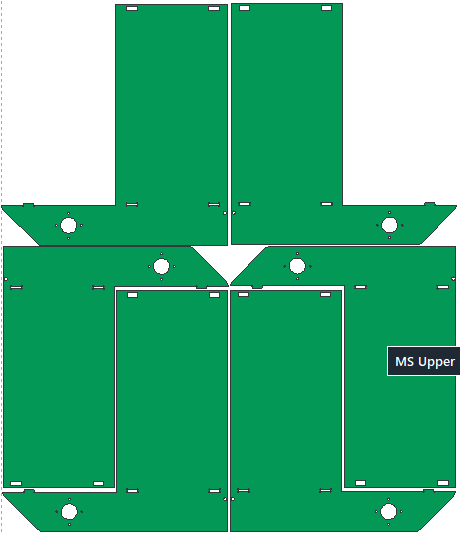
Orientation rules can dramatically change a nest. A part allowed to rotate freely may fit into gaps that a fixed part cannot use. At the same time, careless rotation or mirroring can create unusable components. The correct approach is to define freedom at the part level.
Rotation increments
Common settings include fixed orientation, 90-degree rotation, 45-degree steps, or fine angular increments. Finer rotation increases the search space and may improve true-shape fit, but it can also require more optimization time.
Use fine angles for irregular parts that genuinely benefit. Use larger increments for rectangular work, directional cutting, or jobs where simpler orientation improves unloading.
Grain direction
Rolled sheet and plate can have directional properties. Formed parts may need a bend relative to the grain. Brushed or patterned material has a visible direction. Assign grain constraints before nesting so a dense layout does not create rejected parts.
Mirroring
Mirroring flips the geometry. It can be useful for symmetric parts or when either face is acceptable. Do not allow it when the part contains:
- Countersinks or counterbores on one side
- Etched text or logos
- Left-hand and right-hand relationships
- Protective film requirements
- Formed features
- Directional surface finish
Some assemblies need a controlled quantity of each hand rather than unlimited mirroring.
Long parts and sheet direction
Long narrow parts often nest best parallel to a sheet edge. Unnecessary diagonal rotation may leave triangular waste, complicate handling, or increase machine travel. A good optimizer should evaluate rotations without forcing awkward choices that do not improve net material use.
Part priorities and groups
Critical or large components can be placed first. Parts belonging to the same assembly may be grouped for tracking or production convenience. These business rules can outweigh a small utilization gain.
Parts inside holes
A large internal opening can hold a smaller part when material and process rules allow it. This is useful for frames and rings. The inner part must maintain spacing from the hole contour and should not interfere with cutting stability.
Test constraints deliberately
When a nest looks poor, review whether the software is being restricted unnecessarily. Check fixed rotations, grain flags, mirror rules, group constraints, spacing, and sheet selection. Relax only the rules production permits.
Nest XL exposes rotation, custom angle steps, mirroring, grain, priority, grouping, and hole-nesting controls so the operator can describe the real manufacturing requirements.