
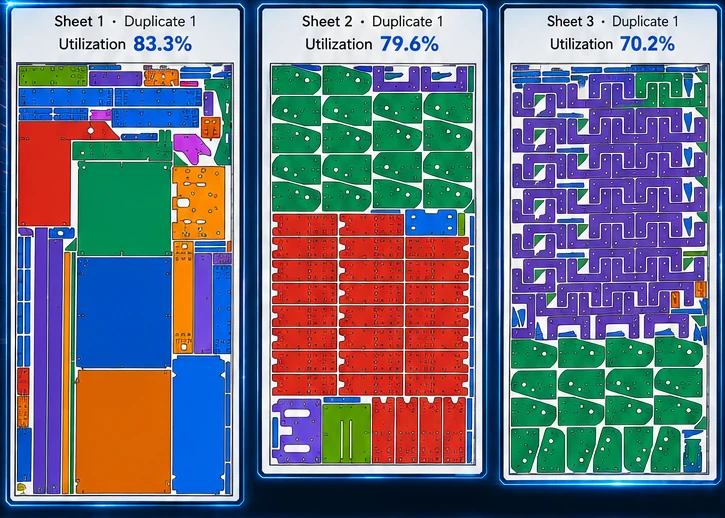
Reducing scrap is not simply a matter of pushing parts closer together. The best material strategy balances nest density, process reliability, stock selection, reusable remnants, and accurate job costing. A layout that saves a small amount of area but creates tip-ups, overheated parts, or an unusable skeleton can cost more than it saves.
Measure the right loss
Track more than total sheet utilization:
- Purchased material consumed
- Part area produced
- Reusable remnant area and shape
- Unusable skeleton and trim
- Scrap caused by errors or recuts
- Material that exists in inventory but cannot be found
This separates optimizer performance from inventory and process problems.
Use true-shape nesting
Bounding-box packing leaves empty space around irregular parts. True-shape nesting uses actual contours, concavities, openings, and compatible orientations. Mixed part sizes can perform well because small parts fill areas between large parts.
Evaluate nesting with different part types, quantities, sheet sizes, and materials. A system should not be tuned only for one familiar job.
Select stock based on net loss
The largest available sheet is not always the best sheet. Compare purchase cost, expected yield, the value of the leftover drop, handling time, and existing remnants that may complete the job.
Nest XL Corporate can evaluate approved sheet sizes and remnant stock so material selection becomes part of the workflow rather than an operator guess.
Preserve a clean remnant
When two layouts use similar material, prefer the one that leaves a large contiguous rectangle or recognizable irregular drop. Narrow channels and fragmented islands are difficult to store and unlikely to be reused.
A remnant needs usable dimensions, material, thickness, location, and identity. Without that information it is only theoretical inventory.
Use production-safe spacing
Spacing must support the cutting process. Consider kerf, heat input, head clearance, part movement, and material thickness. A correct gap protects production quality and reduces recuts, which are a major source of hidden scrap.
Review rotation and grain rules
Overly restrictive rotation wastes material. Overly permissive rotation may violate grain, finish, bend, or production requirements. Assign constraints at the part level and allow flexibility only where it is safe.
Connect quoting to the actual nest
If quotes assume perfect theoretical yield, the shop absorbs the difference between estimated and actual material use. Use the nest to calculate consumed material and include setup, machine, pierce, and handling costs.
When a quote is approved, Corporate workflow can move it into production, consume selected stock, and record qualifying remnants.
Organize physical remnant stock
Assign rack or bin locations, label remnants with material and thickness, record the actual shape, remove unusable pieces, and audit inventory periodically. Use older or awkward remnants before opening new stock when practical.
Reducing scrap is a continuous business process. The largest gains appear when nesting, quoting, stock selection, and remnant management share the same information.