
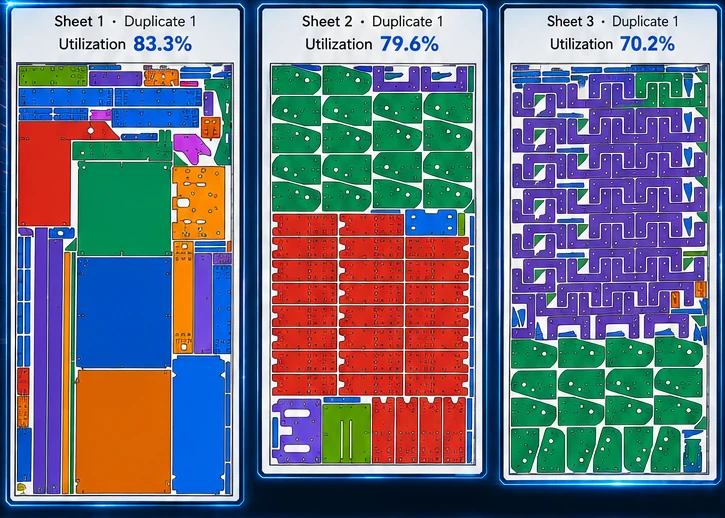
Plasma cutting nests must balance plate utilization with heat, kerf, part movement, consumable life, and practical unloading. A tight-looking arrangement is not useful if parts weld back into the skeleton, tip up, or require recutting.
Use process-appropriate spacing
Spacing depends on amperage, material, thickness, kerf, heat-affected zone, and machine performance. Use shop-proven minimums rather than an arbitrary visual gap. Maintain enough edge margin for clamps, damaged plate edges, and reliable arc starts.
Protect small and narrow features
Thin webs, sharp internal corners, and small holes may not cut exactly as drawn. Geometry review should identify features below the process capability. Nesting software cannot correct every manufacturing limitation, but it should preserve the intended contours and make review possible before production.
Count pierces in the quote
Pierces consume time and consumables. Thick plate can require substantial pierce delay, height control movement, and lead-in distance. A quote based only on perimeter may underprice a job with many holes.
Consider heat and part stability
Avoid creating long unsupported strips that can move during cutting. CAM can distribute heat through sequencing, but the nest establishes the physical relationship between parts. Larger and heavier parts may need room for safe removal.
Use mixed sizes effectively
Place large profiles first and use smaller brackets or tabs to fill compatible areas. True-shape placement can use concavities and openings that rectangular packing overlooks.
Track plate and remnants
Plate is often one of the largest job costs. Record material grade, thickness, heat or lot information when required, dimensions, unit cost, and storage location.
When a nest leaves a useful drop, capture its shape and identity so it can be selected for future work rather than forgotten in the rack.
Quote from the production plan
A plasma quote may include plate consumed, cut length, pierce count, delay, expected feed rate, machine hourly rate, consumables, setup, handling, grinding, material markup, and margin.
Nest XL keeps those inputs connected to the job's DXF parts and nested sheets. Corporate workflow can release approved quotes to production and update internal stock.
Review more than utilization
Compare the nest against real shop objectives: plate changes, handling, clean leftover material, risk of part movement, and total cost. The highest percentage is not always the lowest-cost production plan.